That Little Sample Chip Is Not Your Floor: A 48-Hour Reality Check

Photo: Internet Archive Book Images, No restrictions, via Wikimedia Commons
A flooring sample is a marketing object. It's been chosen from the prettiest part of the pallet, handled by a hundred people, and lit by a spotlight with a colour temperature chosen to make it sing. Then you take it home, drop it on the carpet, and wonder why it looks grey.
This isn't a swindle. It's just physics and photography and a bit of human eyesight. But it costs people real money every year, usually in the form of a floor they don't love, or a reorder they didn't budget for.
So here's why the chip lies, and what to do about it before the order goes in.
Showrooms are lit to sell, not to tell
Light has a colour temperature, measured in Kelvin. A typical showroom runs 3500–4000K — crisp, slightly cool, brilliant for making greys look expensive. Your living room probably has 2700K warm bulbs, or a mix of whatever was on offer at the DIY place, or nothing but a north-facing window.
North light is the big one in the UK. It's cool, blue-shifted and remarkably consistent, which means warm-toned woods go flat and grey-toned laminates can tip towards a cold, slightly clinical cast. A south-facing room at 4pm in July will do the opposite and push warm oak towards orange. Neither is a fault. Both will surprise you.
And here's the bit people forget: most of us use our living rooms after dark. The floor you see at 8pm under two lamps matters more than the one you saw at midday.
Scale is doing more work than you think
Twenty centimetres of anything looks tidy. Forty-five square metres of it looks like a different material.
Plank width and length change the whole character of a room. A 190mm board in a small box room reads calm and domestic; a 260mm board in the same space can look like decking. Long planks in a narrow hallway stretch it beautifully — right up until the repeat pattern appears and you notice the same knot four times in a row.
Repeat is the giveaway. Ask how many unique plank faces are in a pack. If the answer is vague, assume it's low. Cheap laminates and some LVT ranges run repeats of six to eight faces, which is fine in a bathroom and faintly hypnotic across an open-plan kitchen-diner.
Sheen, grain and which way the light falls
Two floors can have identical colour and completely different characters because of surface finish. Matt hides dust and shows scuffs. Satin shows everything at a low angle. Polished porcelain throws window light halfway up a wall.
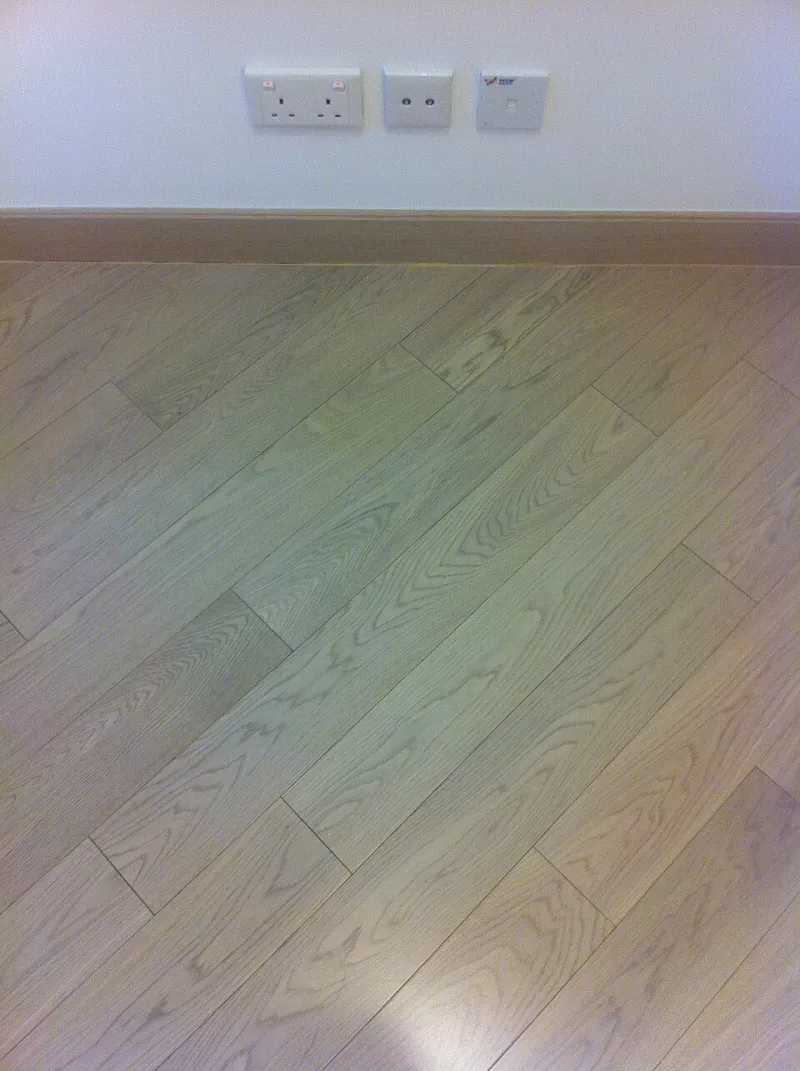
Grain direction matters too, and it isn't just aesthetics. Run planks down the length of a room and it feels longer. Run them across and it feels wider. Run them towards the window and every board edge catches the light; run them parallel to it and the floor goes quiet and flat. Neither is wrong — but you should choose it deliberately rather than letting the fitter start at the door.
Batch variation is real, and it isn't a defect
Timber and stone are natural; LVT and laminate are manufactured. Both vary between production runs. Dye lots shift, calibrations drift, and what arrives in six weeks may not match the chip you've been carrying in your coat pocket since March.
This is why overage matters. Ten per cent is the sensible domestic allowance, and 15 per cent for herringbone, chevron or diagonal layouts. It's also why you should ask for the batch or shade reference on the order confirmation — and why we'd rather tell you honestly that a batch won't match than have that conversation on fitting day.
The 48-hour sample test
Do this properly and it will save you a decision you'd have regretted.
- Get a full-size piece. A whole plank or tile, not a chip. Ask for two, ideally from different packs.
- Lay it dry on the actual subfloor, in the actual room, with no underlay and no rug underneath. Underlay changes the look of a floating floor more than people expect.
- Leave it there for 48 hours. Not ten minutes and a photo.
- Look at it at three times of day — first thing, mid-afternoon, and after dark with the lights on.
- Stand back five paces, then look from 30cm. Both views matter. Nobody inspects a floor on their hands and knees except fitters and buyers.
- Check it against everything it'll live next to — skirting, kitchen units, sofa fabric, the dog. Colours only make sense in company.
- Turn it 90 degrees and see how the grain direction reads. This is the cheapest design decision you'll ever make.
- Spritz it with water. On tile and LVT that reveals the real sheen. On timber it's a rough preview of how a finish will read.
- Take a photo each day at the same time — and then ignore the photos a bit, because phone cameras colour-correct aggressively.
- Turn the lights off and use only daylight, then repeat with lamps. Two floors, one sample.
Questions to put to your contractor before the order goes in
- Can you supply a sample from the same batch we'll actually receive?
- What's the shade or calibre range within a single order, and how much variation should we expect?
- Which direction will it be laid, and what's the repeat count in the range?
- What overage percentage are you allowing, and does that change for herringbone?
- Will the adhesive or underlay alter the appearance — colour, sheen, visible joints?
- What's the plan if the delivery doesn't match the sample?
Ask those before the deposit, not after. A good contractor will have answers ready; the silence from a bad one tells you plenty.
Where this leaves you
Treat the sample as a starting point rather than a promise. A floor is a large, quiet, light-reflecting surface that you'll look at every day for fifteen years, and it deserves more than a two-minute squint in a showroom. Give it 48 hours in your own room, in your own light, and you'll make a decision you can actually live with.
Which is, honestly, the whole point.