The Chair Is the Client: A Home-Office Floor Built Around Castors, Cables and Camera Angles
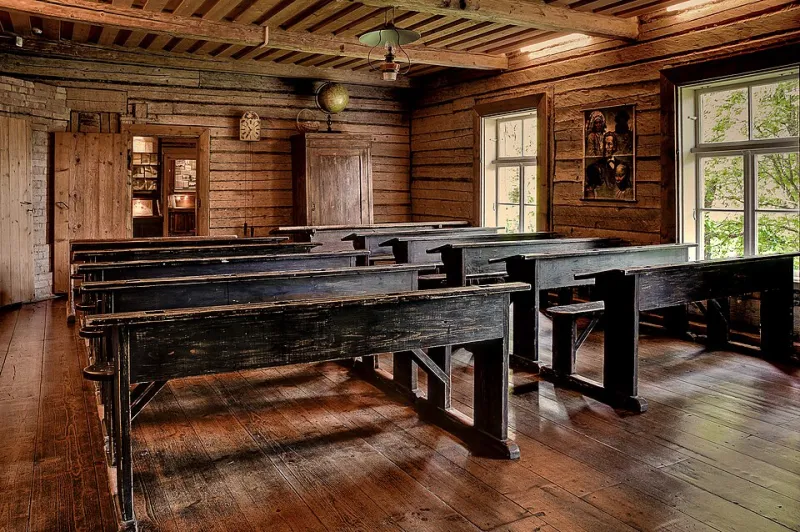
Photo: Rauno Kalda, CC BY-SA 3.0 ee, via Wikimedia Commons
A home office is a small room with a surprisingly specific set of demands. It is not just a desk parked in a spare bedroom. It is a place where a chair rolls back and forth for hours, where a monitor and a rising desk put weight in the same few spots, where cables need somewhere sensible to go, and where the floor has to behave itself on a video call. Get those basics right and the room feels calm. Get them wrong and you will be listening to a castor crunch across a loose board every time you join a meeting.
This is not a case for ripping up the whole house. Most home offices are retrofits: a spare bedroom, a landing desk, a corner of a garden room. The trick is to spec for the room you actually have, then choose a finish that still looks like it belongs there.
Start with the chair, not the swatch
Office chairs are the hardest-working piece of furniture in the room. The load is not spread evenly. Most of it lands on five small castors, and when you lean back or push away from the desk, those castors concentrate weight into tiny contact points. On a soft carpet, that shows up as flattened patches and tracked lines. On a hard floor, it shows up as scratches, dulling and the familiar clatter of plastic wheels over a hollow-sounding board.
The first decision is therefore less about colour and more about contact. A low-pile carpet with a firm backing will cope better than a deep, spongy pile that swallows the castors. Carpet tiles are a practical option because a worn patch near the desk can be swapped without replacing the room. If you prefer a hard floor, look at luxury vinyl tile or engineered wood with a suitable wear layer, and think about glides or a chair mat rather than leaving hard plastic castors to do their worst. Soft castors or felt glides are a cheap upgrade; a replacement floor is not.
Desk legs matter too. A standard desk has four small feet. A height-adjustable desk can put even more pressure through a narrow footprint, especially when it is raised and someone leans on it. Felt pads or proper glides protect the surface, but they do not fix a floor that flexes. In older UK homes, check for movement in suspended timber floors before you assume the floor is level just because it looks flat.
Cables need a route before the floor does
A home office without a cable plan becomes a home office with a rug over a power lead. That is not a flooring solution. Before the final floor goes down, decide where the router, monitor, lamp, phone charger and desk power are going to live. If you have floor sockets, make sure they are accessible and not buried under a desk leg. If you do not, plan a perimeter route along the skirting, behind furniture, or through a proper floor trunking system.
Trailing leads across a walkway are a trip hazard, and cables trapped under underlay or a floating floor can create high spots and noise. In a garden room or converted outbuilding, cable entry needs the same thought as insulation: keep it sealed, keep it tidy, and keep it away from anywhere water might sit. A floor is much easier to work around before it is finished than after.
Calls are an acoustic problem, not just a visual one
Hard floors look smart in a home office, but they also bounce sound. A room with bare boards, a plastered wall and a desk can turn every video call into a slightly echoey experience. You do not need a recording studio. A rug under the desk, a bookshelf, curtains and a bit of soft furnishing will take the edge off. If the room is very bare, an acoustic underlay beneath a hard floor can help, and carpet tiles are a sensible choice where sound comfort matters as much as appearance.
Then there is the camera. A glossy floor reflects light, including a window or a ring light, and that can wash out the bottom of the frame. Very dark floors can make a room feel like a cave on screen. Very pale, high-shine finishes can flare. A matte, mid-tone finish is usually the safest background for a working day of calls. Busy patterns can shimmer when the camera moves, so if you want pattern, keep it away from the desk zone or choose something with a calmer repeat.
The camera reads colour differently
A sample chip that looks warm and inviting in the hallway can look grey and cold through a laptop camera. That is not a reason to panic; it is a reason to test. Take a sample into the room, put it where the desk will sit, and look at it on a video call in daylight and again with the room lights on. Warm oak tones tend to read naturally on camera. Cool greys can be crisp, but they can also turn blue under some LED bulbs. Very yellow-toned finishes can look brassy on screen.
This is also where the 48-hour sample rule earns its keep. A floor is a large area of colour. What works as a small chip can become overwhelming across a whole room, especially in a spare bedroom that is doing double duty as a workspace.
A room-specific spec check
In a spare bedroom, the main risks are castor wear, desk-leg dents and noise travelling through a suspended floor. Check the boards for movement, use a suitable underlay, and choose a finish that can take a chair. On a landing desk, traffic is the issue: the floor has to cope with the office chair and the rest of the household walking past. Keep the edges tidy, avoid loose rugs near the top of the stairs, and make sure any cable route does not cross the walkway. In a garden room, temperature swings and sunlight are the extra tests. Choose a finish that is stable in changing conditions, and do not ignore the doorway threshold where the garden room meets the house.
The no-lift-house rule is simple: work room by room, protect the route to the door, and accept that a home office floor does not have to match the whole ground floor. It has to survive the working week, look deliberate on camera and feel comfortable underfoot. The chair, the cables and the calls will tell you what the room needs. The colour comes after that.